GenAI Micro Journaling
for Emotional Resilience Building
Mobile App, Adaptive AI
May 2026
2026 MFA UX Design- Thesis Selected Award
Project Overview
MERO is an AI-powered lifestyle app that turns everyday lived experiences into emotional awareness, personal reflection, and a truer sense of self — reframing social media as a micro journaling tool that grows with you.
Problem
Gen Z spends hours inside feeds engineered for retention, yet consistently feels worse after doom-scrolling. Overexposure to curated content turns ordinary life into a comparison contest.
Journaling is the most effective tool for building emotional awareness and resilience, but mood-logging apps ask people to adopt an entirely new habit — and engagement rarely lasts.
The mechanics that make social media addictive — self-expression, adaptive algorithms, retention-driven design — are not harmful in themselves. Pointed at reflection instead of comparison, they could work for the user.
Role
Independent researcher and product designer
Institution
College for Creative Studies
Instructor
Ian Lambert/ Evan Carpenter-Crawford
Responsibility
Led end-to-end research and development of a master’s thesis topic, presenting a possible design solution to address the research question.
Why do Gen Z feel worse after doom-scrolling?
Social platforms are optimized for retention, not for wellbeing. I started by asking what keeps people inside the feed, and what actually builds emotional awareness.
Overexposed to curated content
Constant exposure to edited highlight reels turns ordinary life into a comparison contest, and self-worth into a metric.
Journaling works, but rarely sticks
Journaling is the most effective tool for building emotional awareness and resilience — yet it demands a deliberate habit most people never form.
Mood logging loses engagement
Existing mood-tracking apps ask users to input data but give little back, so the habit fades within weeks.
Why is social media so addictive?
Self-expression
What draws people in
Adaptive algorithm
What keeps them there
Retention & ads
What the platform optimizes for
Design Opportunity
Reimagine social media as a micro journaling tool for emotional awareness and personal growth for Gen Z, rather than a source of comparison, anxiety, and social pressure.
Familiar
Built on an existing mental model. There is no learning curve to overcome.
Effortless
No new habit to build and no behavior change required — people already post about their lives.
Addictive by design
The same loop that keeps people scrolling is pointed at reflection: the more you use it, the healthier you become.
Virtuous Engagement Loop
The concept framework is a loop that begins in real life, passes through the app, and pushes the user back out into the real world.
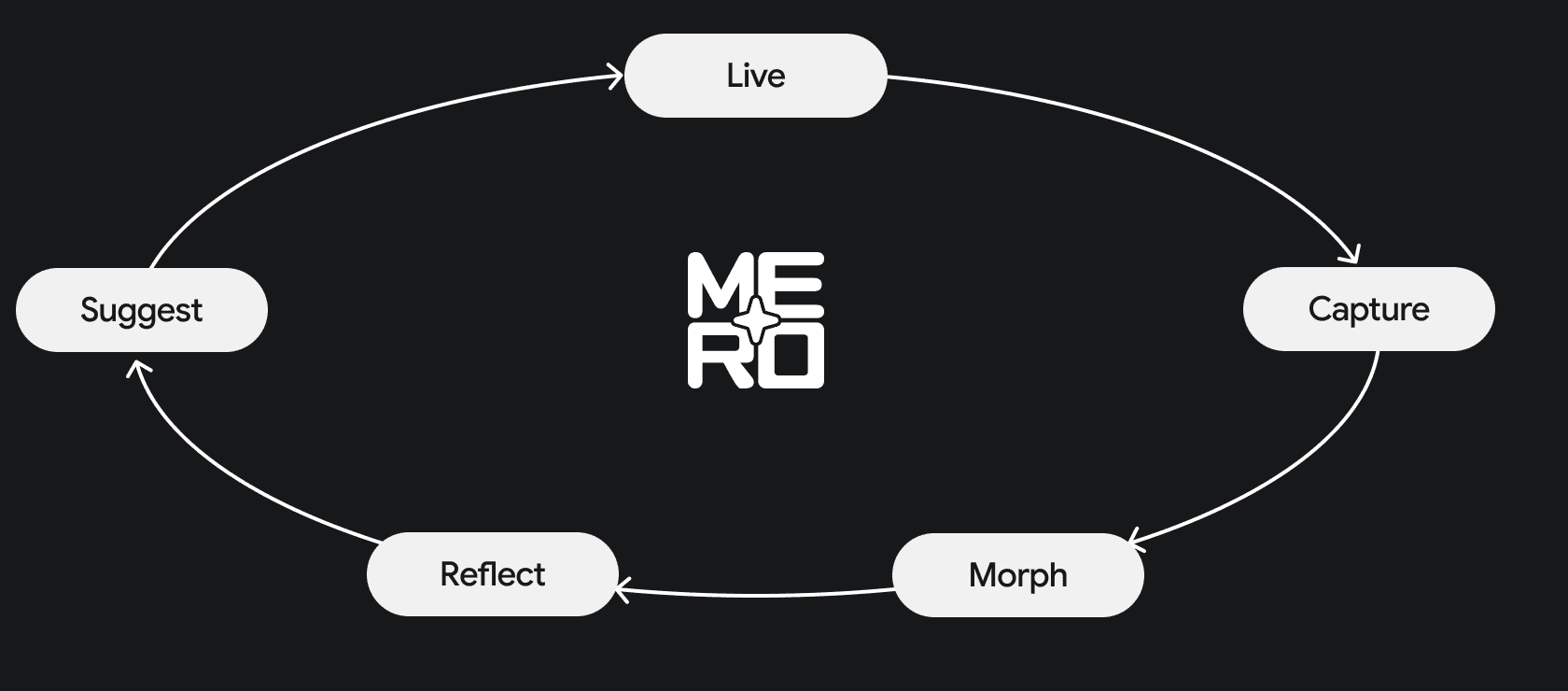
Live
Real World
Real life happens first
The user goes out and experiences the world — a meal, a workout, a conversation, a creative moment.

Capture
Real to Digital
Capture the moment
The user records the experience through a photo, a short video, or a written reflection. This is the only way to progress in the app.

Morph
Digital layer
The digital presence reacts
Their digital presence updates through verified lived experience, so it becomes a genuine mirror of who they are rather than a curated performance.
Reflect
Digital layer
AI surfaces hidden patterns
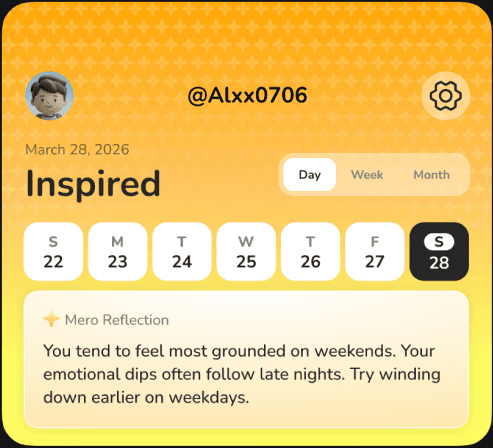
Adaptive AI analyzes accumulated content over time — identifying recurring emotional triggers, surfacing unrecognized joy or frustration, and reflecting patterns back quietly through adaptive UI color.

Suggest
Digital to Real
AI nudges back to the real world
Based on emotional patterns and personal context, MERO suggests meaningful real-world actions: activities, places, or experiences that close the loop.

Adaptive UI
Color system
What do the colors mean?
The interface takes its color from the emotional state MERO reads in recent entries, so the palette carries the reflection before a single word of it is read.
Experience Flows
Three moments across the product lifecycle: a first-time user, two weeks in, and two months in.
@Alxx0706
First Time User
A college student notices MERO through mainstream social media and captures a first moment to unlock the app.
@Sarahhh
~ 2 Weeks
A start-up employee documents how she feels each day under a tense schedule, and MERO begins to notice the pattern.
@Maycraft
~ 2 Months
A freelance designer starts feeling bored by recent work, so MERO surfaces users with similar experiences and relevant real-life events.
User Feedback
Two Gen Z users tested the concept — one an active social media user, one not. Each responded to a different half of the loop.

“As a gamer, I actually want to go out and do things in real life, just to see how my avatar changes.”
25, Male · Active social media user

“Layered presence made me feel safe enough to share moments without caring how I looked.”
27, Female · Non-active social media user
Brand & Motion
The identity system in motion — how MERO builds its mark, holds attention, and shows up beyond the app.
Brand Identity
Full identity film
Logo Construction
Grid system and mark build
Attract Loop
Looping screen for idle states
Out of Home
Digital billboard placement
Reflection
Testing surfaced the two halves of the loop working independently — and that split turned out to be the most useful finding.
The gamer wanting to go out and do things in real life just to see how his avatar changes is the Suggest stage running in reverse: the digital layer pulling behavior back into the world. The second user feeling safe enough to share without caring how she looked is the Morph stage doing its job, lowering the performance pressure that makes conventional social media exhausting.
MERO does not need to convince anyone to journal. It needs to make the digital reflection interesting enough that living becomes the way to change it. What I would test next is whether that motivation survives past novelty, and where the line sits between a mirror that encourages honesty and one that becomes another thing to optimize.